For many COOs and operations leaders, “we don’t have the IT team for this” is treated as a reason to shelve the conversation. It shouldn’t be. Two established deployment models exist, and one of them was built specifically for organizations without dedicated technical staff.
Ask an operations leader why their organization hasn’t moved on AI voice agents and the answer is usually practical rather than skeptical: no internal AI team, no spare engineering capacity, and no appetite to stand up a new technical function inside an already stretched department. That answer treats deployment as if only one model exists. Build it internally, or don’t do it at all.
It overlooks a second, equally established model that already exists for exactly this situation.
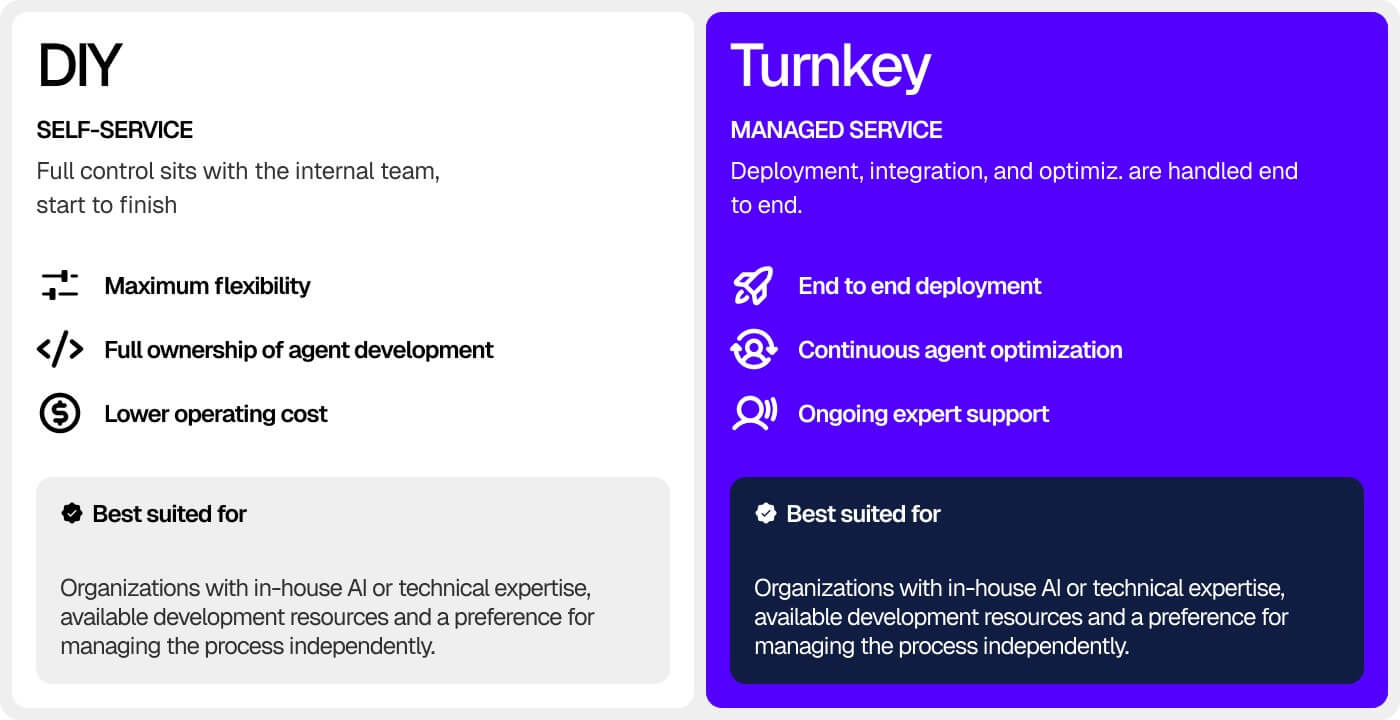
Two deployment models are available for AI voice agent implementation today, and they are built for opposite starting points. One assumes the organization wants to own and build the capability internally. The other assumes it does not, and was designed around that assumption from the start rather than as a stripped-down version of the first.
What Are the Two Deployment Models for AI Voice Agents?
Most operations leaders exploring voice AI aren’t hesitant because they lack interest in the outcomes. Reduced cost per contact, consistent scripting, and extended coverage hours are all attractive. The hesitation is narrower: they assume someone will have to be personally responsible for the system once it’s live, and that this responsibility requires dedicated AI or IT expertise the organization doesn’t have on staff.
That assumption, not a lack of ambition, is what stalls the conversation. It’s also the assumption the two deployment models exist to address directly.
What This Actually Looks Like
Stated abstractly, both models can sound identical. In practice, they produce a working agent doing specific, concrete work.
A typical turnkey deployment for a debt relief operation covers importing accounts from the CRM, placing outbound calls to assess hardship and payment capacity, scheduling follow-up consultations where needed, and logging every outcome back into the CRM automatically.
The workflow is the same whether 10 calls are made that day or 10,000.
A mortgage servicing deployment looks similar in shape: borrower outreach, document status updates, and payment reminders, routed and logged the same way.
The deployment model determines who builds and maintains that workflow, not what the workflow does.
Turnkey: The Deployment Model Built for Organizations Without an IT Department
Many people assume turnkey is simply DIY with some of the work outsourced. It isn’t.
It’s a separate engagement in which a provider team owns every technical stage, from agent development and prompt design through integrations, testing, launch, and ongoing optimization.
The organization’s role is limited to supplying information and approving decisions at defined checkpoints.
For operations leaders without a standing IT function, under a turnkey engagement there is no parallel track where an internal engineering team needs to be assembled, a technical hire needs to be made, or existing systems need to be re-architected first.
No internal IT staff participation and no process modification are required to launch.
What the Provider Actually Owns
“No IT department required” is a claim worth breaking down rather than taking at face value.
Under a turnkey engagement, the provider team is responsible for:
CRM, telephony, and LMS integration
Prompt design and conversational logic
Pre-launch call testing and QA
Voice selection and configuration
Post-launch optimization and performance monitoring
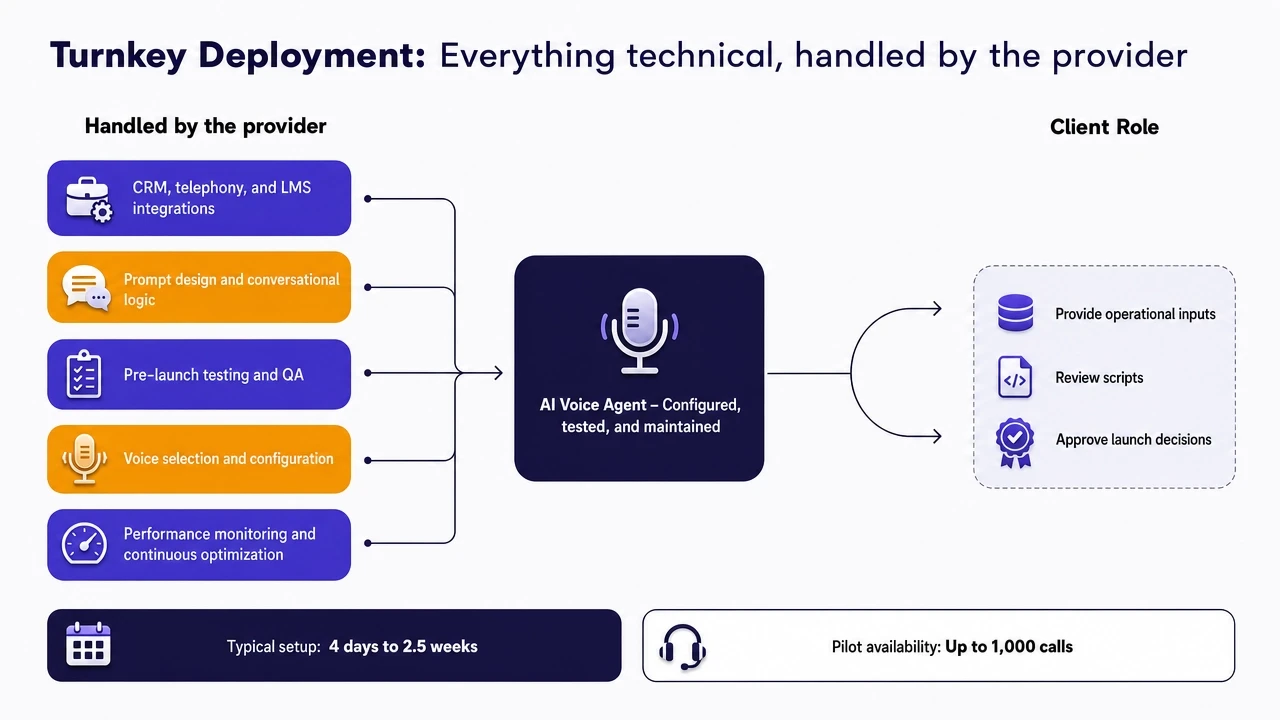
Setup timelines in production deployments have ranged from 4 days at the fastest to about 2.5 weeks for a more complex, multi-system integration.
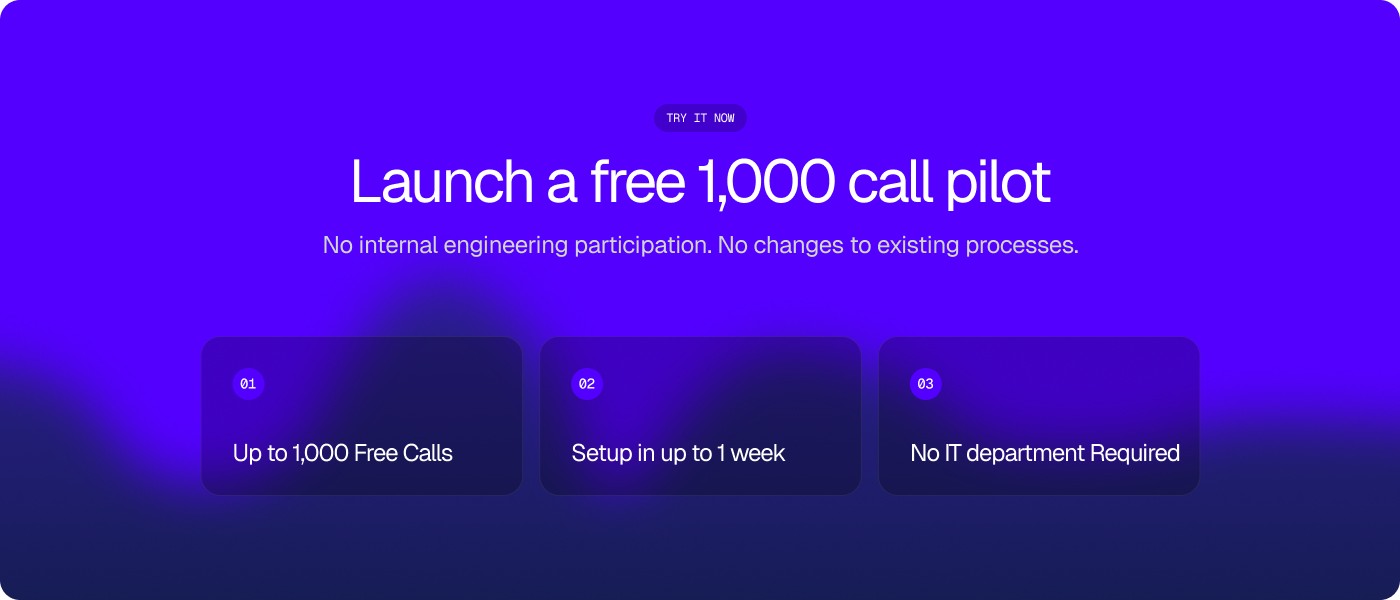
A 1,000-call free pilot is available to test the model before any commitment.
How Does a Turnkey AI Voice Deployment Work? The 6-Step Process
The timeline above isn’t a single fixed number because deployments follow a defined sequence of stages, and the time each one takes varies with script complexity and integration scope.
The sequence itself does not vary:
Discovery. The provider team gathers call samples from top-performing agents, along with the product and process detail needed to build an accurate script.
Script design. A conversational script is drafted and reviewed jointly with the organization before development begins.
Development and integration. The approved script is built into the platform and connected to the organization’s CRM, telephony, and LMS systems.
Pilot. The agent goes live on a defined subset of call volume, typically within the free pilot allowance.
Evaluation. Performance is reviewed against the pilot’s goals, and adjustments are made based on the organization’s feedback.
Production launch. The pilot converts into full production coverage and an ongoing engagement.

Same Platform, Same Capabilities, Different Owner
The capability list is identical between the two models. What changes is who executes it.
Capability | DIY | Turnkey |
|---|---|---|
AI agent development | Self-managed | Fully managed |
Prompt design and optimization | Self-managed | Fully managed |
CRM, telephony, and LMS integrations | Self-managed | Fully managed |
Voice selection and configuration | Self-managed | Fully managed |
Testing before launch | Self-managed | Fully managed |
Post-launch optimization | Self-managed | Fully managed |
Continuous improvement from feedback | Self-managed | Fully managed |
Expert support | Self-managed | Fully managed |
What Does the Organization Still Do Under Turnkey?
A managed engagement is not a hands-off engagement.
The organization’s involvement is concentrated at specific decision points rather than distributed across every technical stage.
In practice, that means:
Providing top-performer call samples and process documentation upfront
Reviewing and approving the script before development begins
Participating in the pilot evaluation and requesting modifications
Signing off before the deployment scales to full production
None of these require a technical background. They require the same operational judgment an ops leader already applies to any vendor decision.
Real Results: What Turnkey Deployment Has Looked Like in Practice
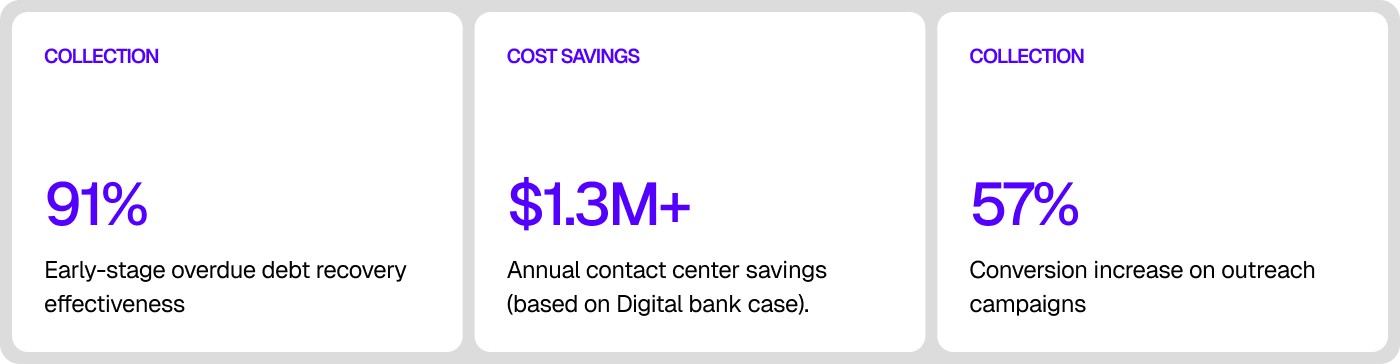
A rapidly developing digital bank facing a scaling problem illustrates the point concretely.
Growing its collections department under the traditional model would have meant hiring roughly 170 additional specialists, securing office space, and building out communication infrastructure.
Instead, the bank moved to a hybrid deployment: AI voice agents handling pre-collections and collections activity through 30 days overdue, with human agents retained for later-stage, more complex cases.
The deployment went live in 4 days and now processes more than 1 million calls a month.
A Lower-Risk Way to See It in Practice
For leaders still weighing whether either model is right for their organization, deployment does not have to mean full call coverage from day one.
Limiting an agent to non-working-hours calls, including early mornings, nights, weekends, and holidays, replaces a silent IVR or an automatic rejection with a resolved interaction, without touching daytime operations or staffing under either model.
It is a way to observe the technology against real call volume and build internal familiarity with it before deciding whether, and how, to expand, without first resolving the DIY-versus-turnkey question at all.
Frequently Asked Questions
How long does a turnkey AI voice deployment take?
In practice, setup has ranged from 4 days to about 2.5 weeks, depending on script complexity and how many systems require integration.
Do we need developers or an internal AI team?
No. Under a turnkey engagement, the provider team owns agent development, integration, testing, and optimization.
The organization’s role is to supply information and approve decisions at defined checkpoints.
Which systems can an AI voice agent integrate with?
Turnkey deployments connect to the CRM, telephony, and LMS systems already in use.
Integration is handled by the provider as part of setup, with no migration required.
How much staff time does a turnkey deployment require?
Primarily time from whoever is closest to the process being automated: supplying call samples, reviewing the script, and evaluating pilot results.
No dedicated technical staff time is required.
Can we start with a single workflow instead of full coverage?
Yes. Non-working-hours coverage or a single campaign type are common starting points, with expansion decided after reviewing pilot performance.
What happens after launch?
Under turnkey, the provider continues to monitor performance and optimize the agent based on live call data as part of the standard engagement, not as a separate add-on.
The Bottom Line
A small or nonexistent internal IT function is not a reason to rule out AI voice agents.
It is simply an input into which of the two existing deployment models to start with.
Turnkey exists specifically for the organizations that assume they do not have that option.