
For most borrowers, obtaining a mortgage is the largest financial commitment they will ever make. The journey is complex, documentation-intensive, and often spans for a long time. In such a high-stakes environment, communication becomes far more than a customer service function: it is a critical driver of borrower confidence, engagement, and ultimately, conversion. How consistently, transparently, and proactively a lender communicates can have as much influence on the customer experience as the loan product itself.
Mortgage is no longer won on rates alone. It is won on responsiveness.
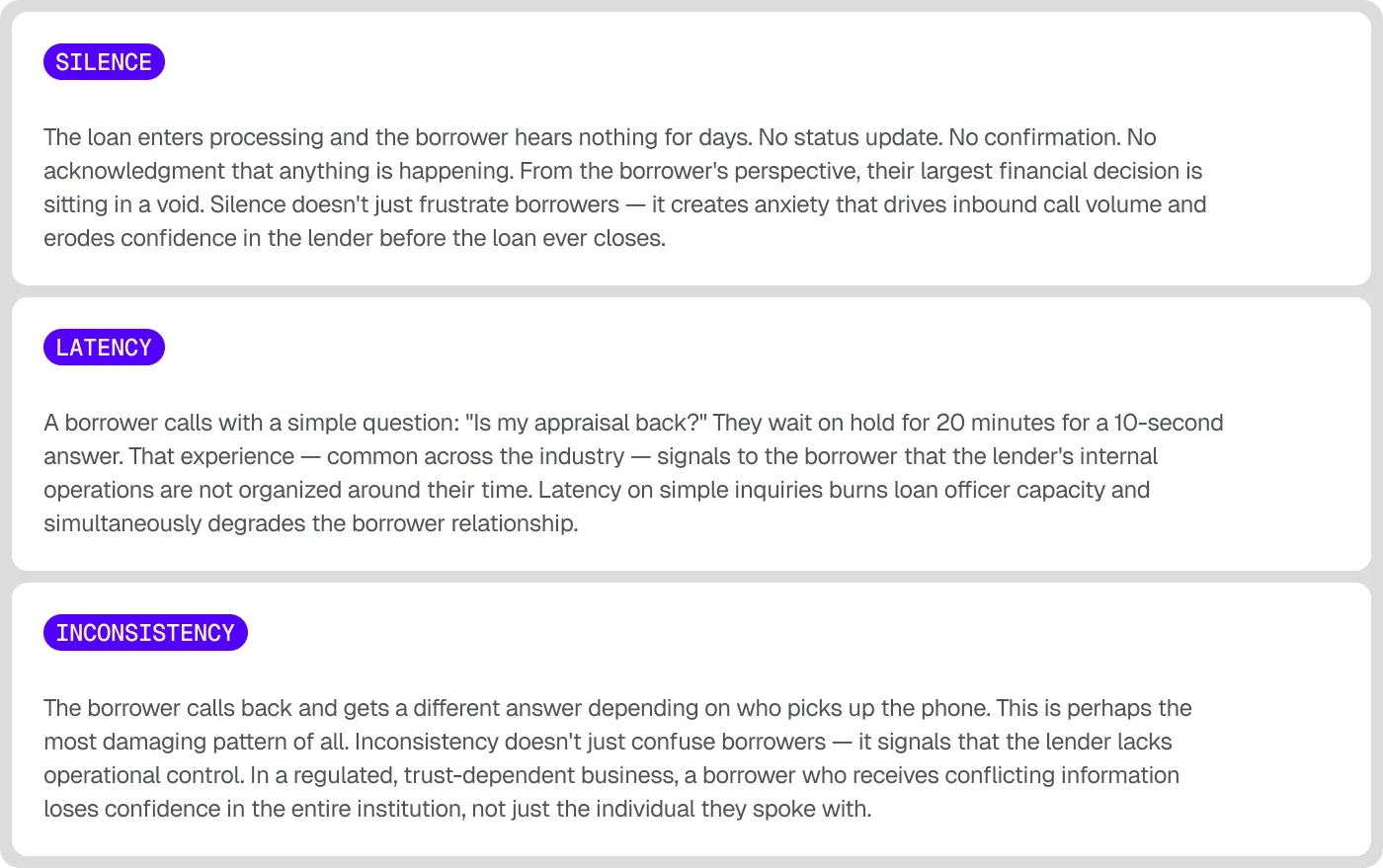
While communication challenges vary across organizations, many lenders exhibit similar patterns that undermine the borrower experience. These shortcomings seem to consistently fall into three recurring categories that weaken trust and affect operational performance.
Having spent nearly seven years at the intersection of mortgage operations and process optimization (at Mr. Cooper, and now as COO at Americor), I've seen these patterns play out across organizations of every size in remarkably consistent ways. And they're costing lenders more than most realize.
The Failure Patterns That Erode Borrower Trust
These communication failures share one characteristic: they are highly repetitive, operational in nature, and do not always require human expertise. That is precisely where modern Voice AI creates value.
Where Voice AI Creates the Most Operational Value
The highest-value moments for AI in mortgage operations are the ones defined by repetition, urgency, and availability. These are precisely the interactions that drain loan officer capacity without requiring their expertise, and where automation can improve borrower experience rather than diminish it.
Lead follow-up is the clearest example. Speed-to-contact has a direct and measurable impact on conversion. When a borrower submits an inquiry at 9pm, the difference between an AI that responds in minutes and a voicemail that waits until morning is often the difference between a live opportunity and a lost one. AI coverage doesn't just protect conversion: it eliminates a structural disadvantage.
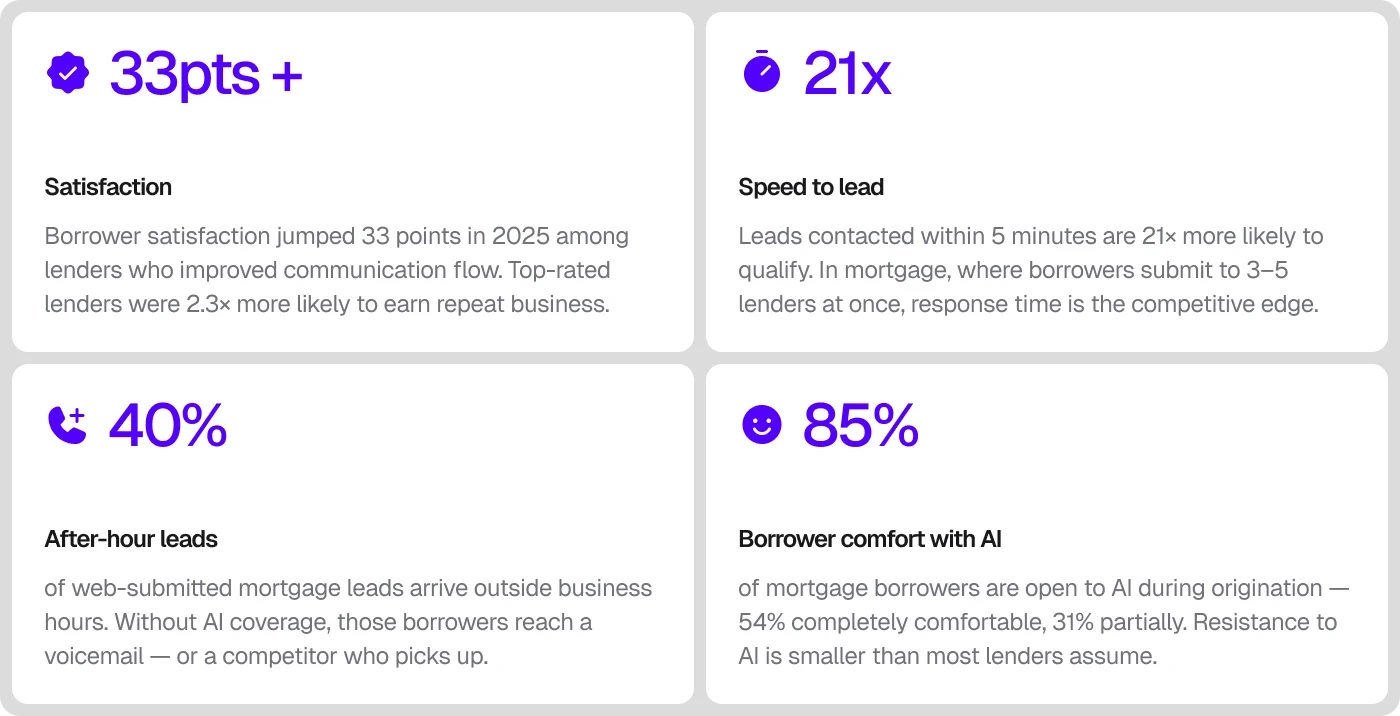
Industry data has consistently shown for over a decade that the 5-minute window is the difference between a live opportunity and a lost one, and in mortgage, where borrowers submit to 3-5 lenders simultaneously, that window is measured in seconds, not minutes.
High-Value AI Use Cases in Mortgage Operations
Initial lead response, intake & pre-qualification: Immediate outreach to new inquiries, basic qualification questions, and appointment scheduling, before a loan officer's time is committed.
Nurturing aged leads: Consistent, personalized follow-up on leads that have gone cold, a high-volume, low-complexity task that AI executes at scale without degrading quality.
Appointment scheduling & confirmation: Scheduling, rescheduling, and confirming appointments with realtors, appraisers, and borrowers, administrative work that consumes meaningful loan officer time without requiring their expertise.
Proactive application status updates: Outbound calls at key milestones (conditional approval, appraisal completion, clear to close) dramatically reduce inbound "where are we?" calls and measurably improve borrower satisfaction.
Document reminders for stalled loans: Stalled loans cost money. AI-driven reminder calls that walk borrowers through exactly what's missing and how to submit it are more effective than email and less expensive than loan officer time.
After-hours borrower inquiries: Mortgage companies typically staff phones 8am-6pm. Borrowers call at 8pm because they just got off work. AI coverage of after-hours inbound reduces abandonment, improves satisfaction scores, and surfaces urgent issues before they become complaints.
It's Not Just Cost Savings
A significant portion of inbound mortgage call volume, typically 35-50%, consists of status inquiries that don't require a loan officer. When an AI agent handles those calls accurately, three things happen simultaneously: the borrower gets a faster answer (often instantly, including outside business hours), the loan officer reclaims 90 to 120 minutes per day, and inbound queue times drop for calls that do require human attention.
35-50% of inbound mortgage calls are status inquiries that don't require a loan officer
90-120 minutes per day reclaimed by loan officers when AI handles routine inbound volume
24/7 coverage window AI provides vs. typical 8am-6pm staffed operations
The companies that implement this well don't think of AI as a cost reduction play. They think of it as a capacity expansion play that happens to also reduce cost. The distinction matters, because it shapes which use cases they prioritize, how they measure success, and how they communicate the change internally.
Where the Line Must Be Drawn
The design principle I return to consistently is: automate the transaction, humanize the relationship. Routine, data-driven, time-sensitive interactions belong in automation. Trust-building, advisory, and emotionally charged conversations belong with people.
The best implementations create what I'd call a human-backed digital experience: AI handles efficiency, and humans handle guidance, reassurance, and complex decision-making. A borrower should always have an easy and immediate path to a live person.
Appropriate for AI | Must Remain with Human LOs |
|---|---|
Status inquiries & milestone notifications | Explaining loan options and product comparisons |
Lead follow-up & appointment scheduling | Handling borrower objections and affordability concerns |
Document collection reminders | Discussing credit challenges and underwriting exceptions |
FAQ handling & after-hours coverage | Navigating borrower anxiety and emotional distress |
Pre-qualification intake & data capture | Escalated complaints and regulatory-sensitive conversations |
The Compliance Reality in Mortgage
Mortgage is one of the most heavily regulated industries in the U.S. RESPA, ECOA, TCPA, FDCPA, TRID: each of these creates real constraints on what can be said, when, and to whom. An AI voice agent that delivers premature disclosures, makes representations about rates or fees, or contacts borrowers at prohibited times creates regulatory exposure that no efficiency gain justifies.
Every script deployed in borrower-facing AI workflows must be reviewed by compliance counsel before launch. This is not optional, and it's not a formality: it's the minimum standard for responsible implementation.
Equally important: borrowers should never feel trapped in an automated system. Clear, accessible escalation paths to a live person aren't just good practice, in some contexts, they are a regulatory requirement.
The Right Way to Start
For mortgage leaders who are interested in Voice AI but concerned about borrower trust, my advice is consistent: start where AI can only improve the status quo. After-hours coverage is the ideal entry point. If your phones go to voicemail at 6pm and a borrower calls at 7pm, the AI cannot make that experience worse. Build confidence there, learn what works in your borrower population, and expand from that foundation.
The concern that AI could hurt trust is legitimate, and I respect it more than executives who dismiss it. Bad AI implementations absolutely do hurt trust and reduce conversion. But the honest question to ask first is whether the current borrower communication experience is already doing the same, just invisibly.
The lenders who approach AI as a way to give their loan officers more time to do what only humans can do (build relationships, exercise judgment, earn trust) are the ones who will look back in five years and wonder why they waited.
The mortgage lenders that win over the next decade won't necessarily have the lowest rates or the largest sales teams. They'll be the ones who make borrowers feel informed, supported, and confident at every stage of the journey. Voice AI isn't replacing that experience: it makes it scalable.
Implementation Checklist: Before You Launch
Successful Voice AI deployment in mortgage requires operational discipline as much as technical capability. Before going live:
Define clear, bounded use cases
Map full conversation flows
Develop and stress-test scripts
Build strong escalation logic
Establish compliance guardrails
Integrate with live loan data systems
Train internal teams on handoff protocol
Monitor quality and performance continuously
Pilot before scaling