
How replacing call scripts with decision-making architecture changes everything for regulated contact centers.
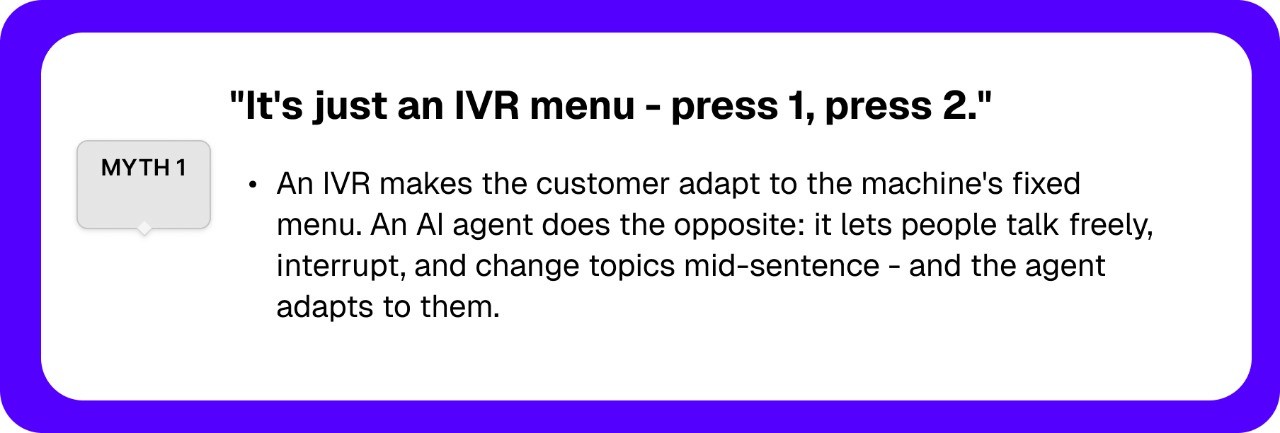
Everyone has been stuck in the voice maze of a standard IVR menu: "Press 1 for payments, press 2 to change your due date, press 9 for a representative."
If your issue isn't on that list, you're on your own - rephrasing, over-enunciating, hoping the system understands. For decades, automation forced people to learn how to talk to machines. For a debt resolution or mortgage servicing operation, this is not a hypothetical - it is the experience your contact center delivers on a large share of inbound calls today.
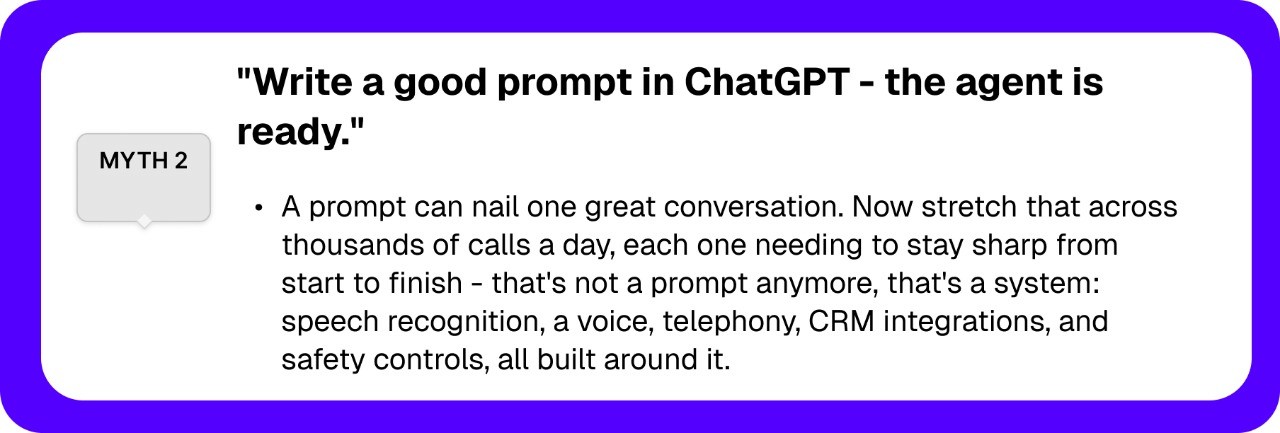
Today, as operations leaders look toward AI, they tend to land on one of two opposite myths.
Both are oversimplifications of what's actually there.
The Change Isn't in the Voice - It's in Who's Adapting
In an IVR, the customer learns the system's language. With an AI voice agent, that relationship flips: the machine learns to understand natural human speech - interruptions, topic changes, pauses, slang, half-finished thoughts.
One of the key differences is the agent's ability to combine natural-language understanding with action: use conversational context to decide whether to retrieve data, execute an approved operation, or route the call. In debt resolution and mortgage servicing operations specifically, this is the difference between a system that only sounds helpful and one that can verify an account, log a payment commitment, or reschedule a due date.
How AI Agents Understand Customer Intent, No Matter the Wording
On a real call, no one reads from a script. A customer who can't pay today might phrase it a dozen different ways: hesitant, blunt, apologetic, negotiating, and the agent has to catch the same meaning in all of them:
"I can't do it today."
________________________________________________________________
"There's no money until payday."
________________________________________________________________
"I can only manage Friday."
________________________________________________________________
"Not happening right now, honestly."
________________________________________________________________
"Could I pay in a few days instead?"
In a traditional scripted approach, these variations need to be anticipated and mapped to the appropriate logic. An AI agent can interpret them in context and determine the next step without enumerating every possible phrasing.
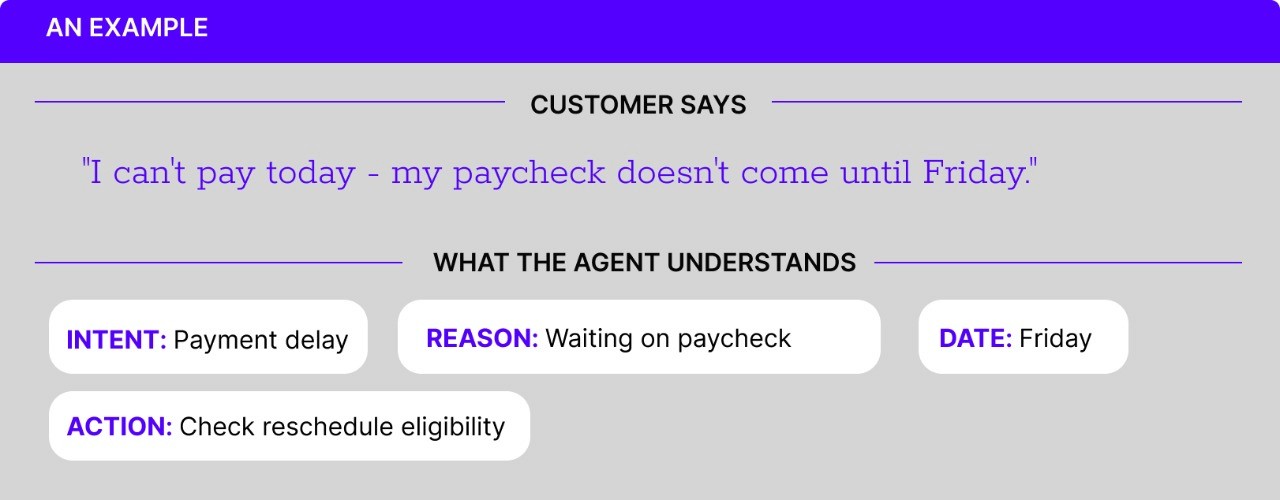
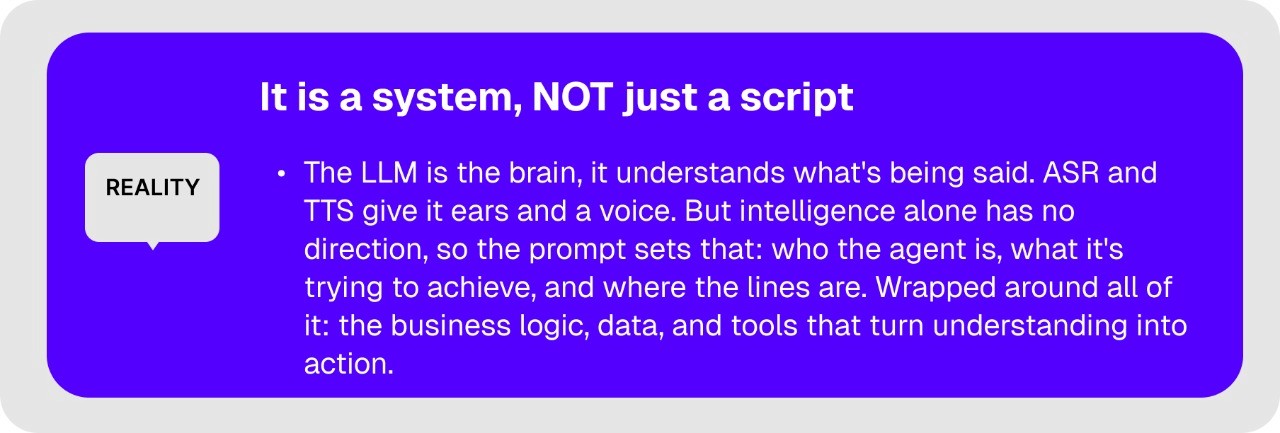
The complexity of conversational AI doesn't disappear once an agent understands a sentence - it simply shifts. Instead of scripting thousands of individual phrasing options, your core challenge becomes designing the decision-making architecture behind them: defining valid reasons, acceptable payment dates, escalation triggers, and mandatory logging. In a high-volume contact center handling thousands of collections or servicing calls daily, this system runs on every single interaction, without exception.
In a regulated environment, this architecture carries even more weight. It isn't just where conversation is understood; it is where compliance is actively enforced. Turning a language model into a enterprise-grade solution requires an entire supporting stack: a rules engine, live tool integrations with customer data, real-time compliance safeguards (FDCPA, TCPA, Regulation F), and deterministic escalation logic.
The ultimate question for business leaders isn't just whether an AI can hold a conversation, but whether it reliably makes the right decision every single time while remaining strictly inside regulatory boundaries.
In the next article of this series, we will break down what this underlying architecture is built from and how teams verify its stability call after call.
We build compliance-built Voice AI for debt settlement, lending, and financial services operators, architected for 100% script adherence, per-call analytics, and deployment in as little as seven days.


