

I want to start with the result, because it reframes the whole question I get asked most. Six months ago, we put our Voice AI live on settlement authorizations and NSF reschedules for a national debt relief operator: the two revenue-driving conversations, and the two call types most of the industry had already tried and abandoned elsewhere. Over six months, that funnel handled +160,000 call attempts, produced 3,386 verified conversations, and secured 2,210 client commitments. On the exact call type where other AI deployments got pulled, ours got expanded.
The difference wasn't the model. It was the groundwork we did before the first call ever went live. Everything below is that groundwork: what has to be true before you route a single call to AI.
Debt resolution clients stay enrolled for three to five years. That's long enough that a single bad AI interaction doesn't cost one conversation. It sets the tone for every call after it. Get the groundwork wrong, and the mistake compounds across a relationship you've already paid hundreds of dollars to acquire.
Why This Matters Now
Americans entered 2026 carrying record credit card debt. Per the Federal Reserve Bank of New York, total balances reached $1.252 trillion by the end of Q1 2026, up 5.9% year over year, with the average rate on accounts carrying a balance at 21.52%. More households under that pressure means more calls landing on the same queues: settlement authorizations, missed-payment follow-ups, enrollment conversations. It's why debt settlement software and AI-assisted collection have moved from experiment to standard practice.

At the same time, regulatory attention on this exact channel is rising. Complaints about debt collection calls jumped 200% year over year, with more than 400,000 reportsfiled with the FTC.

Acquisition costs are climbing alongside everything else. One lead-gen provider serving the debt settlement space reported a $380 cost per acquisition for a mid-sized operator running traditional web forms, with figures elsewhere ranging as high as $800–$2,000+ per enrollment.

More debt, more regulatory scrutiny, higher acquisition costs. That's the backdrop that makes "can AI hold up on the hard calls" a practical question, not a hypothetical one.
The Real Standard AI Has to Meet
Client experience in debt resolution comes down to three things. Here's what each one means in practice.
Active listening | The agent has to respond to what the client actually said, not just move to the next line in the script. If a client raises a concern, our AI addresses it before continuing, rather than talking over it. |
One-call resolution | The client shouldn't need a second call to get what they came for. Our AI has to have the right information on hand and the authority to act on it, not just answer questions and defer everything else. |
Empathy in every interaction | Debt conversations are personal: missed payments, hardship, stress. The agent has to acknowledge that context, not just process the transaction underneath it. |
The Three Readiness Gates
Voice AI shouldn't go live in a debt settlement call center until each of these gates is closed. Underneath them are the five checks that actually close them.
GATE 1: BUILD ON PROOF
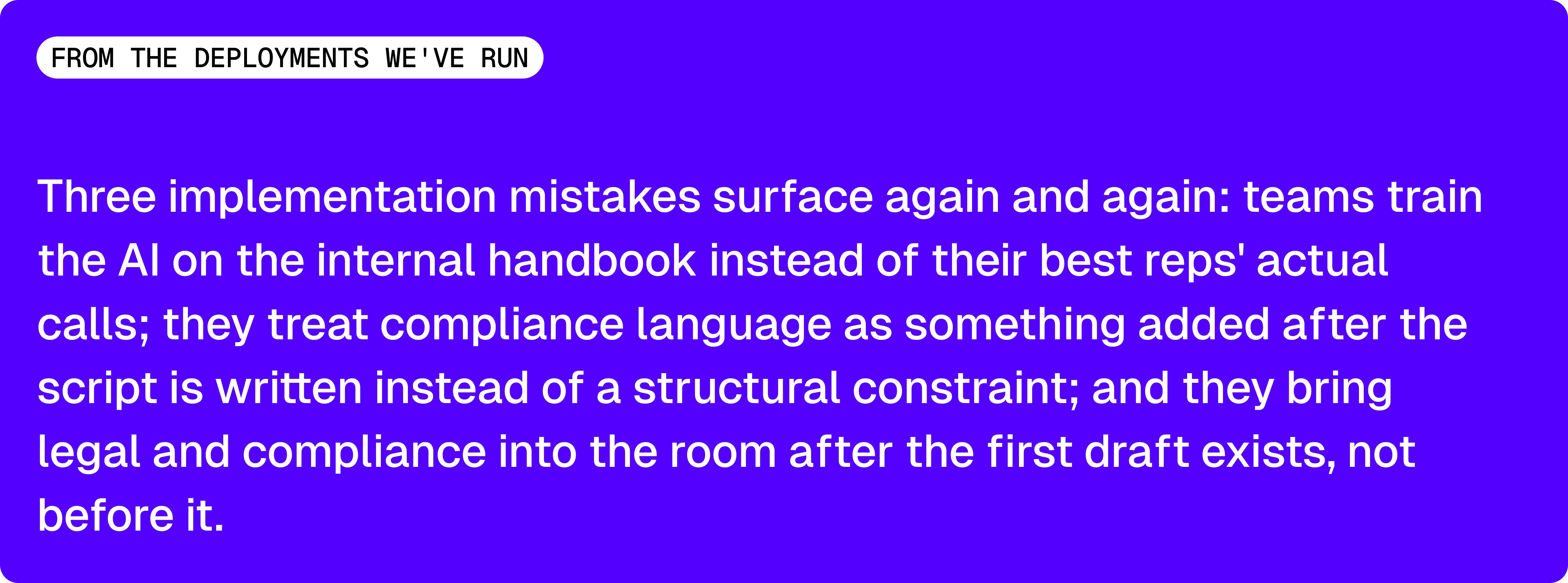
Model the AI on your best calls, not the handbook.
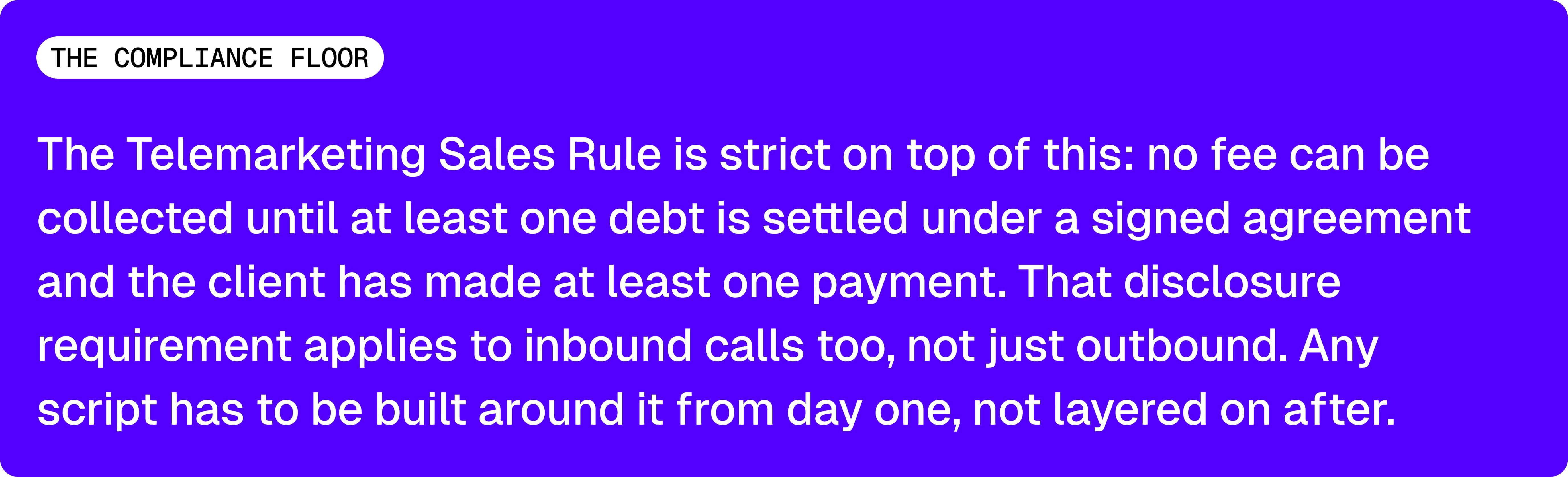
Train it on how your top-performing agents actually handle the call: their pacing, their phrasing, how they defuse tension. Written procedure describes the minimum bar; your best reps show what "good" sounds like in practice.Write compliance into the script as a guardrail, not guidance.
Disclosure language can't be a note appended after the script is done. It has to be structural, built into the flow from the first draft, so there's no path through the conversation that skips it.
GATE 2: DEFINE THE BOUNDARIES
Set escalation rules before the first call, not after the first problem.
Know exactly which call types route to a human, who receives them, and why, decided in advance rather than improvised the first time a call goes sideways.
GATE 3: PREPARE THE PEOPLE
Bring operations, compliance, legal, and training in from day one.
Each function shapes a different part of what the AI delivers. Leave one out of the build and it shows up later: as a compliance gap, a script that doesn't match how the floor actually talks, or a rollout the team wasn't ready for.Prepare the internal team.
Reps need to know exactly what the AI will and won't do, how a handoff reaches them, and how to pick up a conversation smoothly when a client arrives mid-issue from an AI-led call.
What Goes to AI, and What Stays Human
Debt settlement automation isn't all-or-nothing. Two independent operators converge on the same test: complexity and risk decide the bucket, not volume or cost. High-volume, tightly scripted interactions with a measurable outcome belong to an AI agent. Anything that requires reading between the lines, or where a mistake could harm the client or expose the company to regulatory risk, stays with a person.
GOES TO AI | STAYS WITH THE HUMAN TEAM |
|---|---|
Account status updates & routine draft changes | Complex settlements & draft changes |
Settlement presentations | Escalations |
Creditor payment-related interactions | Fraud concerns & litigation risk |
Right-party contact & identity verification | Consultative enrollment calls |
Welcome & onboarding calls | Creditor negotiations, one-on-one |
Payment reminders & NSF follow-ups | Save-the-plan / retention conversations |
FAQ / self-service Q&A | Clients in crisis |
What Clients Actually Notice
Most companies focus on what the AI says. Clients notice how it makes them feel, and that comes down to three things.
Pacing | If a client mentions a bad day and the AI moves straight to the next item, they feel it. A brief acknowledgment builds more trust than any scripted greeting. |
Acknowledgment before action | Confirming the details are right, and checking whether the client has questions before moving forward: the difference between feeling guided and feeling processed. |
Transparency | If a client asks whether they're talking to an AI, the answer has to be direct. And when a call needs to escalate, the handoff has to be clean: no friction, no starting over. |
What This Looked Like in Production
We put this to the test in the hardest way possible. Instead of easing in with reminder calls, we went live in February 2026 on settlement authorization and NSF reschedule calls: the two conversations that drive their revenue, and the two call types the industry had already tried and abandoned elsewhere.
We measured it deliberately conservatively: verified conversations only, reconciled against raw call logs, with every outcome tied to a captured client commitment. The results held up on the calls that matter most.
Metric | Results |
|---|---|
Call attempts processed (6 months) | +160,000 |
Verified conversations | 3,386 |
Client commitments secured | 2,210 (65% of verified conversations) |
NSF reschedule conversion (6 months) | 37–39%, within the 30–50% human benchmark |
Settlement authorization conversion (3 months) | 80%, within five points of an 85% top-human benchmark |
Read those numbers against the call types they came from. NSF reschedules and settlement authorizations are the conversations other operators pulled from AI first: too much on the line, too much nuance. Here, AI matched human conversion inside the accepted range, with disclosure language built structurally into every script, and did it at a scale of 160,000+ attempts that no human team could staff to. On the call type where other deployments got discontinued, ours got expanded.
About the Author
Vitaly Akulov
Founder & Chief Business Development Officer, HubTalk AI
AI Voice Agents for Financial Services
We build compliance-built Voice AI for debt settlement, lending, and financial services operators, architected for 100% script adherence, per-call analytics, and deployment in as little as seven days.
Sources
Federal Reserve Bank of New York, Quarterly Report on Household Debt and Credit, Q1 2026 (released May 12, 2026)
Federal Trade Commission, Consumer Sentinel complaint data on debt collection calls, 2025
Federal Trade Commission, "Debt Relief Services & the Telemarketing Sales Rule: A Guide for Business," updated April 9, 2026
Boomsourcing, "Pay-Per-Call Lead Generation for Debt Settlement," March 27, 2026
Cotality, 2026 AI Trust Survey
HubTalk AI, internal production data and operator interviews, February–July 2026


