About
Debt relief runs on the phone. When negotiators strike a settlement with a creditor, someone calls the client to get it authorized. When a scheduled payment bounces, someone calls to reschedule the draft. When a new client enrolls, someone walks them through their first steps. Every one of those conversations either books revenue or protects it.
For one US-based debt relief company, the math on those conversations had stopped working. A human agent cost $4.50 to $5.00 per call all-in and handled about 760 calls a month. For an operator running 50,000 calls a month, that pace worked out to roughly $250K a month in outbound cost, by the company's model, and it still wasn't enough. By that same model, around 26,000 calls a month sat in a backlog the team could never reach.
None of it was a staffing failure. It was the shape of a business where every call needs a trained human and there are never enough of them.
The problem
Debt relief calls are not appointment reminders. An NSF call reaches a client whose payment just failed, often mid-hardship, and asks them to commit to a new draft date. A settlement authorization call asks a client to say yes to a negotiated deal, with the company's settlement fee riding on the answer.
The industry had already run this experiment. Operators report trying voice AI on NSF conversations, watching conversion land in the 20 to 40% range, and shutting it off. The demos were impressive. The hard calls broke them.
So the bar was specific: perform inside the human band on emotionally loaded conversations, measured using verified conversations and captured commitments. Verified conversation to captured commitment. No demo numbers.
The solution
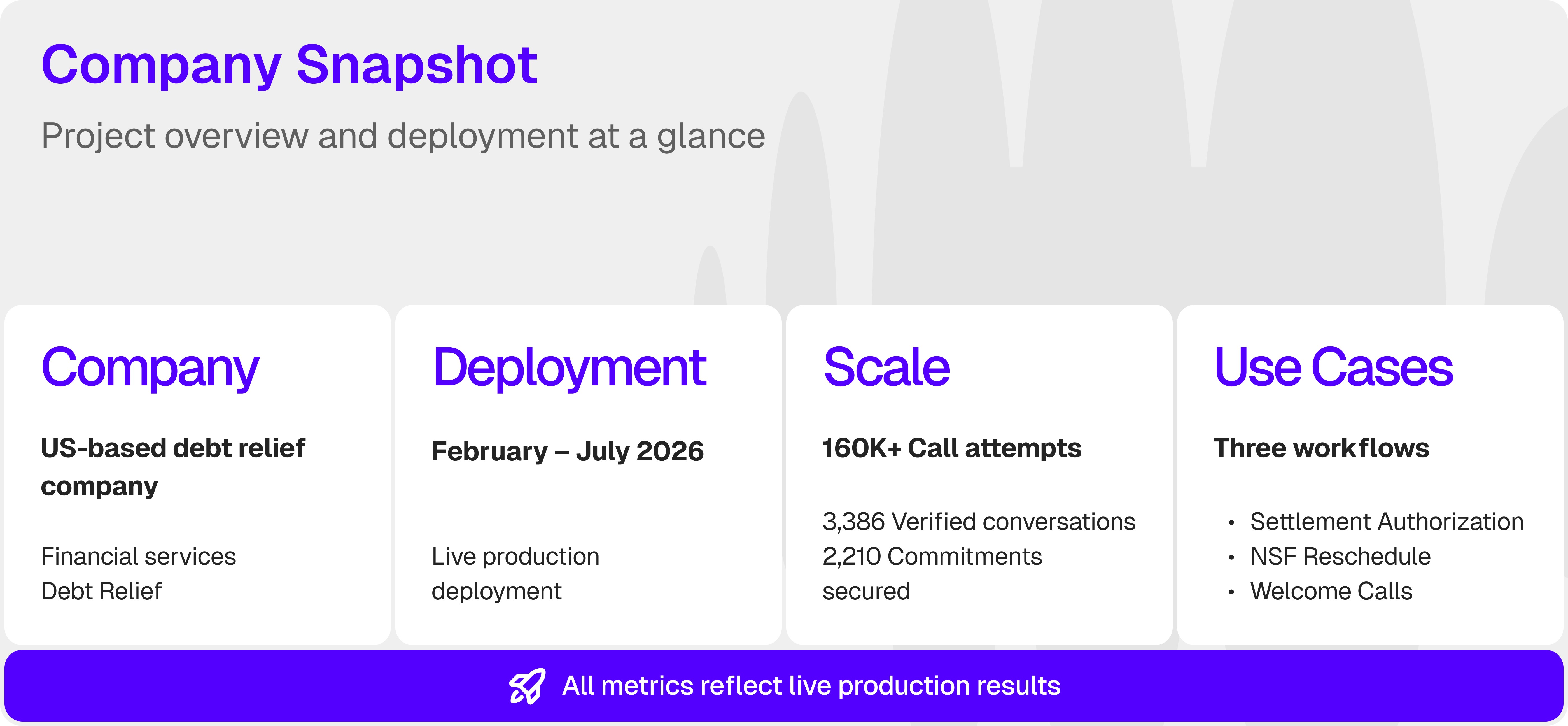
The company put HubTalk AI voice agents into live production in February 2026, and it didn't ease in with reminders. It started with settlement authorization and NSF reschedule calls, the two conversations that drive its revenue, benchmarked against senior debt relief operators.
The measurement was deliberately conservative. Conversion counted only verified conversations, calls where the AI reached the right party and completed identity verification, as the denominator. Every outcome was a client commitment captured on the call, reconciled against raw call logs. Over six months, that funnel ran 160,078 call attempts into 3,386 verified conversations and 2,210 commitments secured.
The call other AI tools couldn't hold
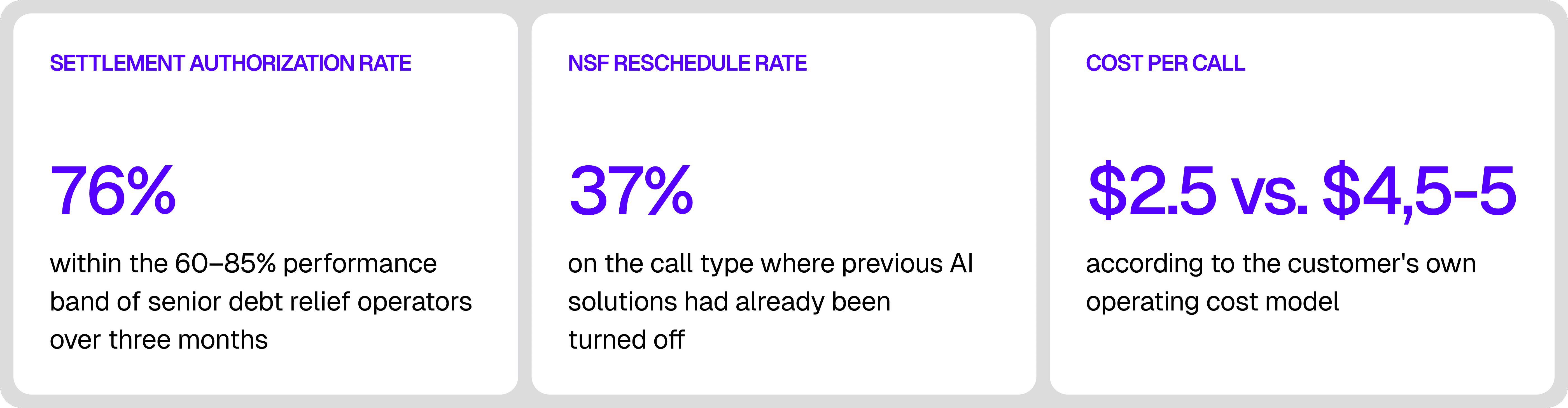
On NSF calls, HubTalk AI converted 37% in February, 37% in March, and 39% in May. A 37% six-month rate, held within a two-point band, against a human benchmark of 30 to 50% with 40% typical.
The consistency is the point. Human NSF performance swings with staffing, tenure, and burnout. The AI's didn't move. On the call type where competitors got discontinued, HubTalk got expanded.
Human-band conversion on the highest-value call
On settlement authorization, HubTalk AI converted 80% of verified conversations over three months, 613 of 764, with February and March both reaching 88%, above the company's 85% top-performer benchmark, before settling to 73% in April. The company's benchmarks put human agents between 60% for newer hires and 85% for top performers.
Operations leadership's read on the AI's settlement calls: "Comparable to human performance of 60-80%."
The results
A HubTalk AI agent costs $2.50 per call and works through 2,500+ calls a month. A human agent costs $4.50 to $5.00 and handles 760. By the cost model the company's SVP of Operations built from actual operating costs, shifting half of a 50,000-call month to AI saves $750K a year. Shifting all of it saves $1.5M.
The backlog that became revenue
The bigger unlock wasn't the cost line. Roughly 26,000 calls a month that previously went undialed are now being made, calls no human team could be staffed to reach. For an operation running around 50,000 outbound calls per month, the company's model estimates that reaching the previously undialed backlog could translate into roughly 1% more settlements approved and approximately $50K in additional monthly settlement fees. The AI didn't just do the existing work cheaper. It did work that wasn't getting done at all.
From servicing into onboarding
In May 2026, the company extended HubTalk AI to welcome calls for newly enrolled clients. In the first month, the AI completed 73.4% of connected calls, and half of verified conversations ended in a warm transfer to a live specialist. Not a replacement for the human team, but a filter that puts specialists on the calls that need them.
Six months of production data settled the question the company started with. The hard calls held, the cost curve bent, and each new call type now ships into the same deployment.